Meaningful and Meaningless Work
A research study analyzed the language people use to describe meaningful and meaningless work. Use the insights to check-in on your own satisfaction at work.

I’ve written previously about purpose as one of the six fundamental human needs. In this context, purpose is about our need to contribute and to be of value, use, or significance, in a specific setting. It’s about feeling that our efforts make a difference, our contributions have value, and we are accomplishing something worthwhile. It arises from roles and responsibilities as well as circumstances. This need for purpose is an everyday thing, not to be conflated with an overarching “life’s Purpose”.
Another way of putting it is that to get our need for purpose met, we need to be doing meaningful work on a regular basis.
Meaningful work has intrinsic value to the person doing it, as well as extrinsic value to the organization in terms of outcomes like turnover and productivity. So it is beneficial to both the individual and the employer for the work to be meaningful.
Quite a bit of research in this area focuses on job attributes (e.g., task variety, significance) as a way to assess and draw conclusions about whether someone’s work is meaningful or meaningless. Less research has been done where people are asked directly about their feelings about work. A study by Martikainen, Kudrna, & Dolan (2022)* offers a qualitative inquiry into how people describe their work when it is meaningful and meaningless.
Research Findings
The researchers asked people about meaningful and meaningless moments at work and analyzed the language they used.
The most common meaningless adjectives were bored, frustrated, tired, useless, and repetitive.
Happy, grateful, and content were the most frequently used adjectives for describing meaningful work.
The study reports that people described meaningless moments more descriptively and vividly. On average, participants used substantially more adjectives when describing meaningless work.
Additionally, the researchers identified four main themes within the various responses.
Contribution Theme
Contribution captures responses about the person’s impact and influence. Responses that described meaningful moments focused on doing something for others, having a social impact, and contributing with one’s own professional skills and knowledge. Anecdotes about meaningless work centered on lacking the ability to create value for others.
Conversion Theme
This category is comprised of responses about the individual. Meaningful moments were focused on individual accomplishment, personal development, and self-growth at work. Lack of achievement or opportunities for self-development characterize the meaningless responses.
Connection Theme
Connection in this context is for responses involving relationships with others. Interestingly, only meaningful moments were associated with this theme. The respondents’ language described sharing, forming, and deepening relationships at work.
Confinement Theme
This theme encompasses work that involves a lack of personal agency or is perceived as a waste of time. This theme was only described in meaningless anecdotes. Responses described feeling restricted, lacking agency or autonomy, a sense of waste of time or effort, experiencing working for an ulterior motive, under outside control, as a mismatch between one’s tasks and the goal of the work, or not being able to participate in decision-making. “Waste of time” was the most common phrase used to describe meaninglessness at work.
*Research Citation: Martikainen, S. J., Kudrna, L., & Dolan, P. (2022). Moments of meaningfulness and meaninglessness: A qualitative inquiry into affective eudaimonia at work. Group & Organization Management, 47(6), 1135-1180.
Reflection Questions
How often do you use the language associated with meaningless work to describe your own work lately? As a reminder, the most frequently used words in that category are bored, frustrated, tired, useless, and repetitive.
How often do you use the language associated with meaningful work to describe your own work lately? The top three words in that category are happy, grateful, and content
When you think about your influence and impact (aka contribution) lately, how meaningful or meaningless is your work?
When you think about your individual accomplishment and professional growth (aka conversion) lately, how meaningful or meaningless is your work?
Would you describe your relationships with others (aka connection) at work as solely falling into the meaningful category?
How much of your work lately falls into the lack of agency or waste of time (aka confinement) category?
Given your answers above, what are three concrete things you might do in order to boost the level of meaningfulness of your work?
Behind the Scenes of MOTIVATED AF
A glimpse into what it takes to write, publish, launch, and perpetuate this book.
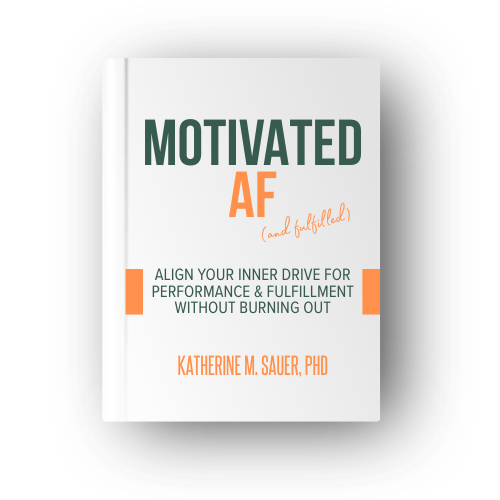
When I was about a month into writing my book, I enrolled in a book accelerator. One of the first things they instructed us to do was to come up with a title for the book and to have a front cover designed.
I won’t lie, it felt very premature.
But in retrospect, it was very good advice and I’m glad I followed it.
The reason they had us get a mockup of our book was to make it real. With a print out of the cover on your bookshelf or desk, you’d see it every day and would be concretely reminded of what your goal is. You’d also be able to use the graphic in early marketing (which is important to start basically as soon as you start writing).
And just because you have a title picked out and cover created, doesn’t mean you’re locked in. I ended up changing my title at least once so far. It’s not a big deal to have it re-designed at this stage. If it were a full cover design including the spine, back cover, and flaps, that would be a bigger endeavor. But just the front? No sweat.
***
Katherine ✨